Start to first client — honest money teaching, done-for-you templates, and real guidance from someone who's actually built one. No clinical qualifications needed. Built around your family.
The course is still being finished — only 20 founding places at founding price, closing 30 September. Join the waitlist to hold yours. You can start today with the Starter Guide + 30-Day Plan.
Why I built this course — and what it'll do for you.
These are Cathy's own real numbers, from her own operating care business — 1st 4 Care (1st 4 Group Pty Ltd, ABN 96 690 366 075 · 0494 800 799), in St Helens, a small town on the east coast of Tasmania. Part-time, on her own terms, fitting around family. If she can make it work there, it can work anywhere.
ABN, business structure, insurance, checks & training, GST — done right, no costly misses.
Know what a support hour pays, how to price, and what you actually keep (gross vs take-home).
Find clients, handle the first meet-and-greet, and keep them with reliable, warm service.
What domestic, meals, cleaning, outings, tech help and errands actually involve — day to day.
The boundaries that protect you and your client — no clinical, no hoists, privacy, consent.
Keep clients, add services, handle the paperwork, and build a trusted local name.
Warm, plain, first-person teaching. One thing at a time — not a wall of theory.
Honest self-check, what the work is really like, and whether it fits your life.
Structure, insurance, GST, ATO, bank account, checks & training — the stuff that costs money to get wrong.
Scheduling, invoicing, records — simple systems that make running it easy.
Where clients actually are, the meet-and-greet, and how to keep them.
Each service, what it really involves, safety & boundaries, the little things that set you apart.
Add services, keep clients, handle the paperwork, protect your business and reputation.
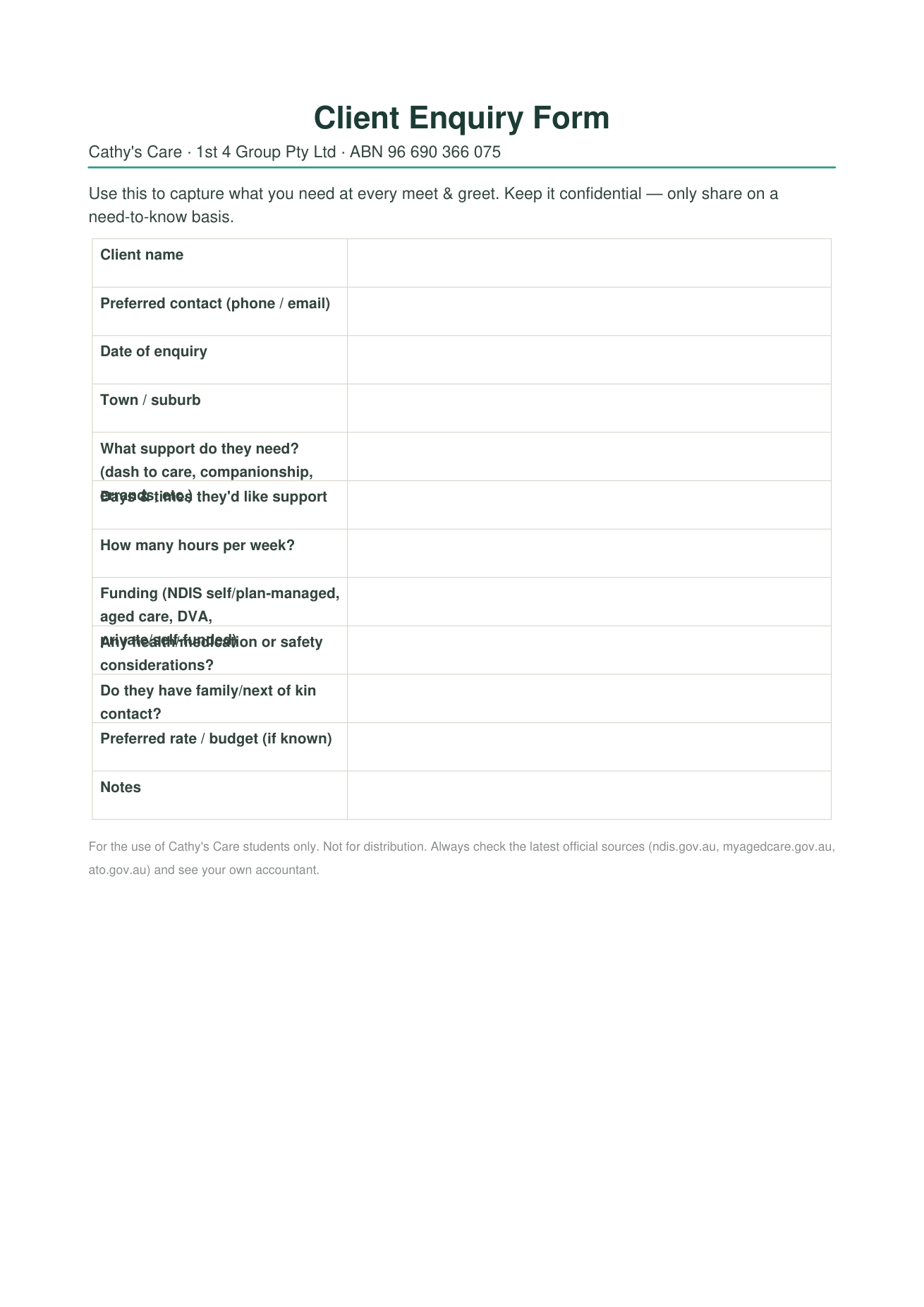
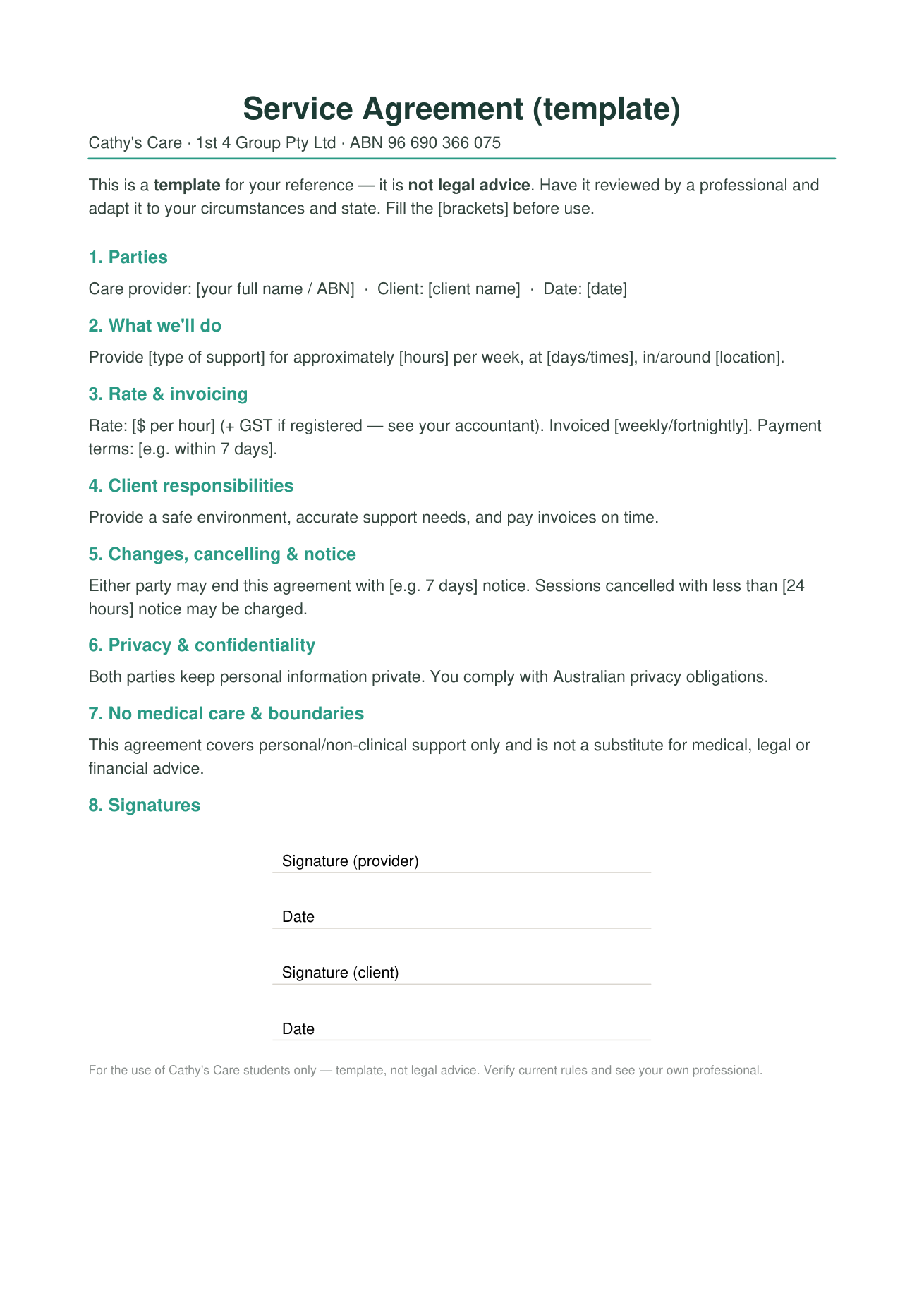
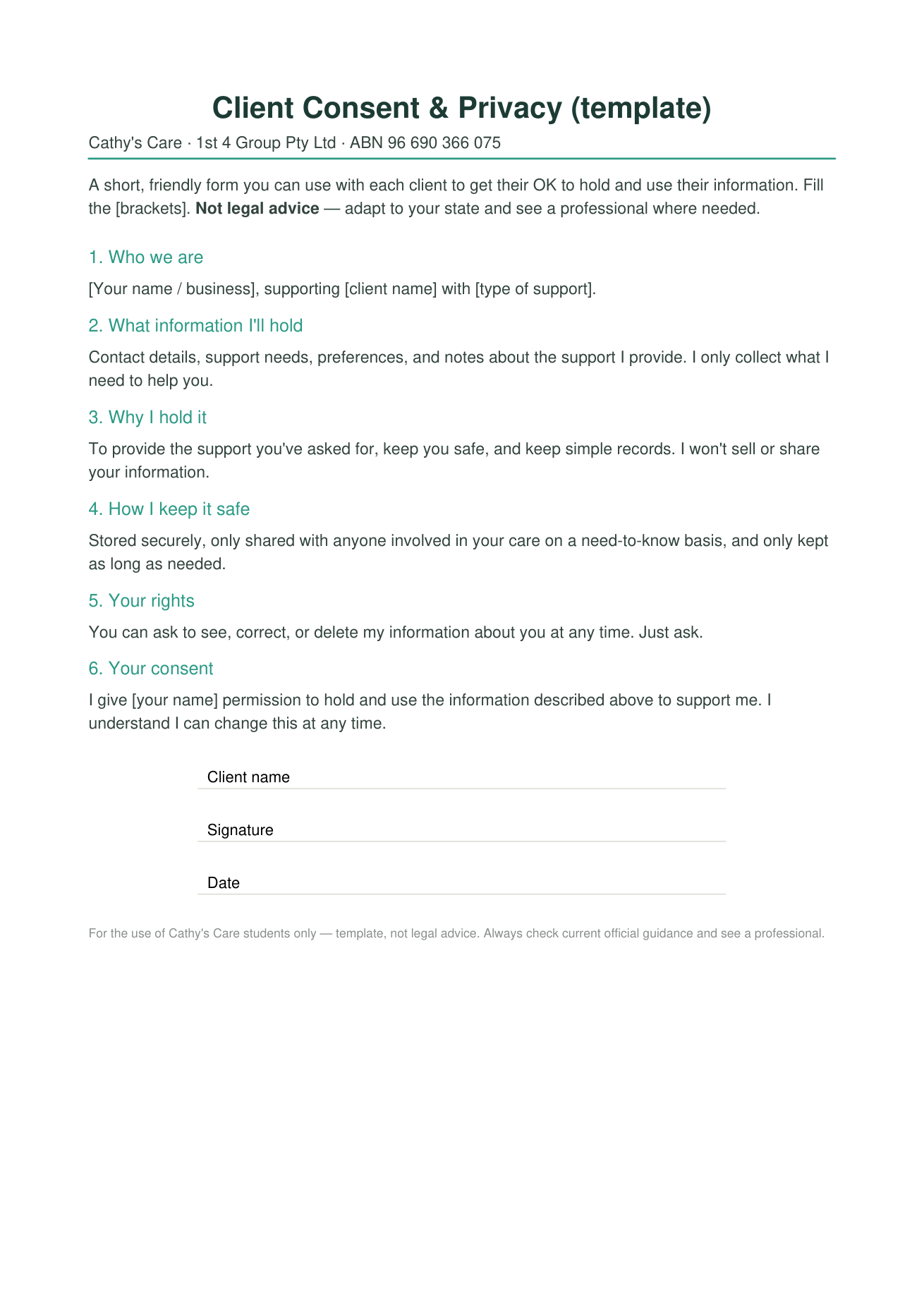
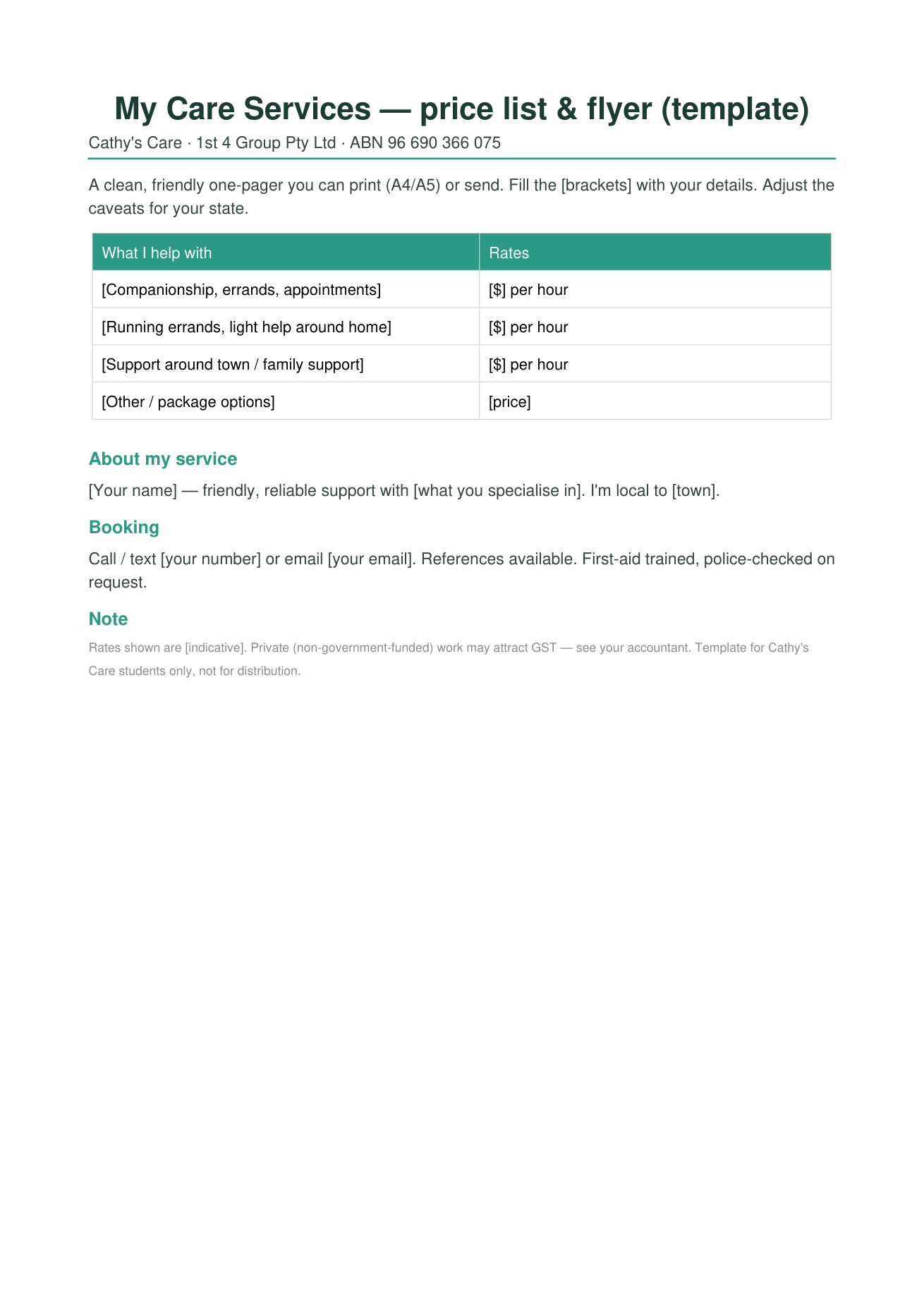
Not mock-ups — the actual done-for-you forms you'll get: client enquiry form, service agreement, consent & privacy form, price list. Fill the [brackets], make it yours.
For some people, the course alone isn't enough — they want a real person in their corner. This tier adds one-on-one time with me.
Direct time with Cathy for your specific questions — set up, rates, a tricky client, your plan. The human last mile nobody else can offer.
The exact coaching tier is worked out once the course is fully built — this is the higher-value option for when you want a real guide, not just a course.
My real numbers, exactly what I earn and keep — before you spend a cent.
Australia-wide · part-time · on your own terms. The course is delivered module by module, and if the first module isn't worth it, you're not charged.
Real stories are on their way — from the founders I'm guiding and the families we support. I'll add them right here as they come in.
"I'm collecting genuine words from the people I work with — no fakes, no made-up quotes. As soon as the first real stories are in, I'll share them here."
Cathy · St Helens, Tasmania
No. We start with everyday support. The "university of life" — your years caring for family — qualifies you more than you think. You'll add the right safety training and checks along the way.
No — and I'd rather say that plainly. This isn't vocational training and it isn't a nationally recognised qualification. It's for self-employment: how to set up and run your own small everyday-support business — what to offer, what to charge, how to find your first clients, and how to keep your records and insurances straight. If you want the Certificate III in Individual Support, that's TAFE — it includes 120 hours of work placement, and it can be fee-free under Fee-Free TAFE if you're eligible. That's a qualification for employed care work. Different job from this one, and you can do both.
Here are Cathy's own real numbers: about $47,000 in care-client revenue over 6 months, part-time (~23 hrs/week), roughly $75/hour. That's a part-time business — a few days a week, fitting around family — and sustained at that pace it's around ~$94k/yr. Weekdays bill around $60–74/hr, and weekends and public holidays pay more — social/community support bills at $103.54 on a Saturday. That's a gross figure — you'll cover your own costs — but it's real and honest, not hype. The $100k is a target, not a promise. See your accountant.
Three main streams, and each has its own entry point. NDIS is the easiest to start with — an unregistered sole trader can support self-managed and plan-managed participants (not agency-managed), and weekends pay more. Aged care (Support at Home) usually needs a registered provider — but you can access it via a marketplace like Mable (which takes a ~10% worker fee, plus a small client-side fee). DVA covers veterans' support through approved providers. Each is taught in the course — including how to invoice correctly and get paid reliably.
Not at all — and I'd hate you to think that. I'm in Tasmania, and it's where I built and proved this, but the work, the rates and everything I teach work right across Australia. Your student resources include a state-by-state guide covering all eight states and territories — NSW, VIC, QLD, WA, SA, TAS, ACT and NT — so you'll apply for the right checks and set up correctly wherever you live. If you're not in Tassie, nothing here is closed to you.
The first modules help you honestly decide whether this work fits your body, your life and your values — before you invest in more. And if the first module isn't worth it, you're not charged.
Head to the free training for the starter kit and the Cathy's Care Starter Guide + 30-Day Plan — the low-commitment way to see if this is for you. ← Back to the free training